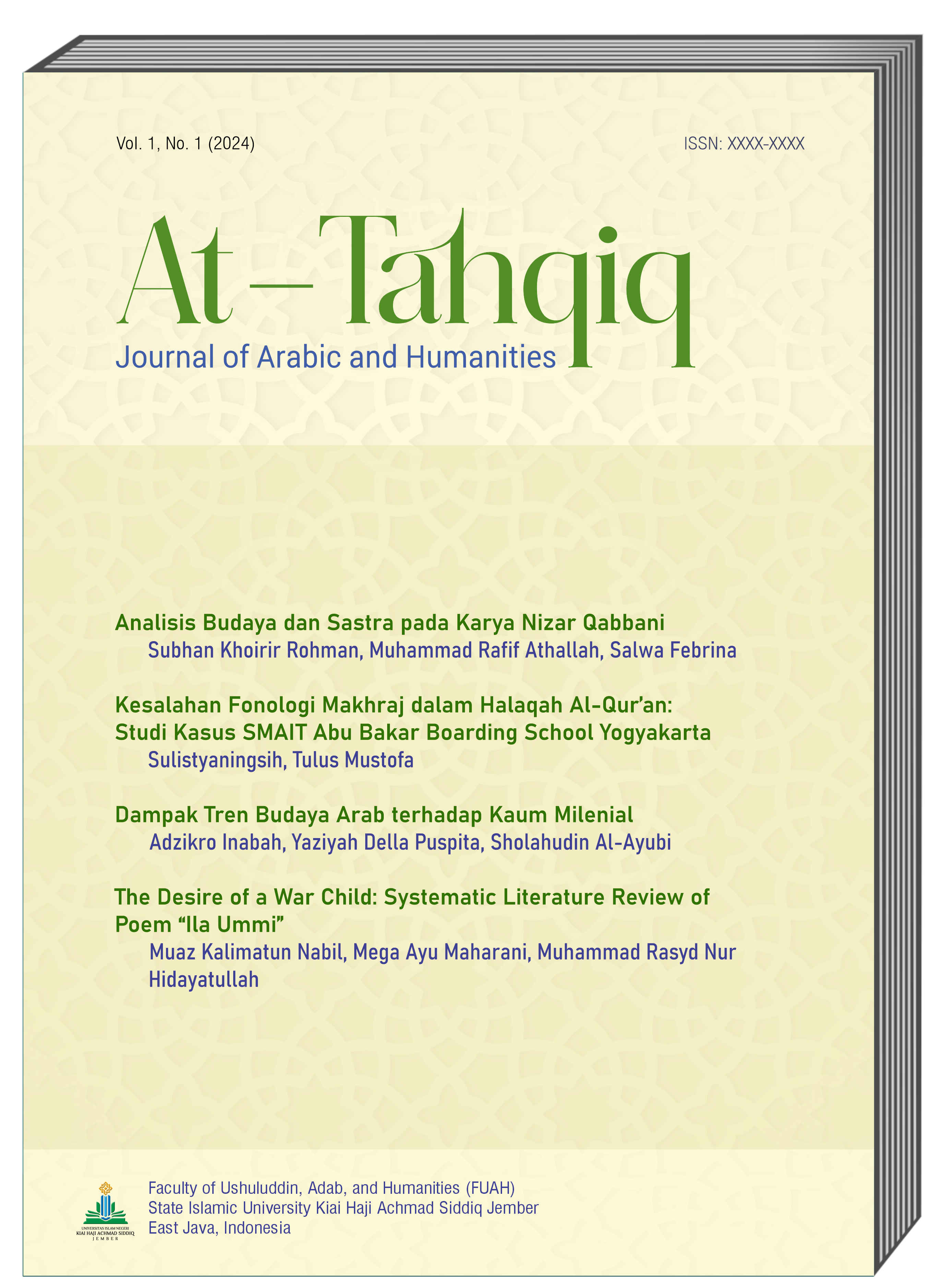
Dampak Tren Budaya Arab terhadap Kaum Milenial di Indonesia
DOI:
https://doi.org/10.35719/attahqiq.v1i1.11Keywords:
Arab Culture, Millennials, Modest Fashion, Digital Media Influence, Cultural IdentityAbstract
This study explores the impact of Arab cultural trends on the millennial generation, examining how elements such as fashion, music, and cuisine influence their lifestyle, values, and identity. Arab culture, with its unique blend of ancient traditions and modernity, has captivated millennials globally. Modest fashion, characterized by the fusion of traditional and contemporary styles, has garnered international attention from both Muslim and non-Muslim communities. Similarly, the distinctive rhythms and melodies of Arab music have expanded millennial music preferences, while the rich and authentic flavors of Arab cuisine have introduced new culinary experiences. This phenomenon raises critical questions: Is the influence of Arab culture positive or negative? How does it affect national identity and local values? Although this topic is essential, previous research has not sufficiently addressed these questions, indicating a clear research gap. To bridge this gap, the study employs a qualitative case study approach, including in-depth interviews with millennials engaged in Arab cultural trends, participatory observation in related events and communities, and content analysis of social media to reveal how these trends are disseminated and received. The findings are expected to provide a detailed understanding of the motivations behind the adoption of Arab cultural elements and their impact on identity and values. This study aims to offer practical recommendations for policymakers, educators, and creative industry stakeholders to promote healthy and constructive cultural interactions. By examining the dynamics of cultural adoption, this research provides valuable insights into the intricate interplay between global and local identities in the digital era.
Downloads
References
Amelia, Baiq Nurrohmi. “Efektivitas Dakwah melalui Musik Gambus Religi oleh Lembaga Seni dan Qasidah Indonesia (LASQI) NTB.” Undergraduate Thesis, UIN Mataram, 2020. https://etheses.uinmataram.ac.id/841.
Astuti, Rahayu Fuji, and Sofiah Aini. “Mengurai Diskriminasi terhadap Wanita Berhijab Syar’i: Perspektif Nilai Kemanusiaan.” An-Nur: Jurnal Studi Islam 16, no. 1 (2024): 127–142. https://jurnalannur.ac.id/index.php/An-Nur/article/view/884.
Aswan, Aswan, and Suhardi Suhardi. "The Development of Islam in Indonesia: Analysis of Existing Theories." Proceedings International Seminar and Conference on Islamic Studies (ISCIS) 1 (2022): 105–117. https://jurnal.uinsu.ac.id/index.php/ISCIS/article/view/13676.
Burnasheva, Regina, Yong GuSuh, and Katherine Villalobos-Moron. “Factors Affecting Millennials’ Attitudes toward Luxury Fashion Brands: A Cross-Cultural Study.” International Business Research 12, no. 6 (2019): 69–81. https://doi.org/10.5539/ibr.v12n6p69.
Damayanti, Sri Ika. “Perkembangan Desain Busana Muslim dalam Tinjauan Sosiologis.” Corak: Jurnal Seni Kriya 3, no. 1 (2014): 53–63. https://doi.org/10.24821/corak.v3i1.2344.
Gulo, Agustinus. “Revitalisasi Budaya di Era Digital dan Eksplorasi Dampak Media Sosial terhadap Dinamika Sosial-Budaya di tengah Masyarakat.” Jurnal Pendidikan dan Kebudayaan 3, no. 3 (2023): 172–184. https://doi.org/10.55606/jurdikbud.v3i3.2655.
Hardani, Nur Hikmatul Auliya, Helmina Andriani, and others. Metode Penelitian Kualitatif dan Kuantitatif. Yogyakarta: CV. Pustaka Ilmu, 2020.
Harun, Makmur Haji, Ahmad Arifai, and Nur Hasan. “The Idea of Arabic Influence Patterns in the Indonesian and Malay Languages.” Educate: Journal of Education and Culture 2, no. 3 (2024): 424–36. https://doi.org/10.61493/educate.v2i03.131.
Kembaren, Mardiah Mawar, Noordin Mohd Noor, and M. Husnan Lubis. “Issues on Arabic Scriptures in Malay Indonesian Language: A Study of Its Contributions in the Development of Regional Culture, Language & Literature Literacy.” International Journal of Culture and Art Studies 3, no. 1 (2019): 15–21. https://doi.org/10.32734/ijcas.v3i1.1661.
Mahabie, Ahans. “Akulturasi Budaya Timur Tengah di Indonesia: Kedatangan Islam dan Pengaruh Budaya.” Mamba’ul ’Ulum 16, no. 1 (2020): 1-13. https://doi.org/10.54090/mu.1.
Ningsih, Rahmah. “Kedatangan dan Perkembangan Islam: Pendahuluan Kedatangan Islam ke Indonesia.” Forum Ilmiah 18, no. 2 (2021): 212–227. https://ejurnal.esaunggul.ac.id/index.php/Formil/article/view/4304.
Qodri, Novian Husen. “Akulturasi Budaya Arab dalam Budaya Lokal Kehidupan Masyarakat Indonesia.” Jurnal Pendidikan Tambusai 8, no. 1 (2024): 18–27. https://jptam.org/index.php/jptam/article/view/12336.
Riskya, Nurrika, and Selvira Yuliana. “Penerapan Data Mining untuk Prediksi Perilaku Pelanggan Menggunakan Multiple Linear Regression.” Jurnal Informatika dan Teknik Elektro Terapan 11, no. 3 (2023): 489–496. https://doi.org/10.23960/jitet.v11i3.3194.
Sartika, Rina Aditya, and Nurbaiti. “Kebudayaan Islam Sebagai Literasi pada Generasi Milenial.” Aplikasia: Jurnal Aplikasi Ilmu-Ilmu Agama 22, no. 1 (2022): 81–94. https://ejournal.uin-suka.ac.id/pusat/aplikasia/article/view/2698.
Shofura, Syifa, Muhammad Ihsan, and Siti Safira Al-Latifatuzzahra. "The Arrival of Islam in Indonesia: A Theory of Islam's Spread." Juspi: Jurnal Studi Keislaman 8, no. 1 (2024): 127–133. http://dx.doi.org/10.30829/juspi.v8i1.19700.
Tamara, Shafira Shada. “Akulturasi Kebudayaan Arab di Indonesia.” SEMNASBAMA: Seminar Nasional Bahasa Arab 5 (2021): 290–301. https://prosiding.arab-um.com/index.php/semnasbama/article/view/798.
Taqiyyah, Risydah, and Maman Lesmana. “The Influence of Arabic Culture on Betawi Arrominia Gambus, Indonesia.” Asian Journal of Language, Literature and Culture Studies 4, no. 3 (2021): 201–212. https://journalajl2c.com/index.php/AJL2C/article/view/87.
Tibbetts, G. R. "Early Muslim Traders in South-East Asia." Journal of the Malayan Branch of the Royal Asiatic Society 30, no. 1 (1957): 1–45. http://www.jstor.org/stable/41503106.
Wardaya, Awwali Ibnu, Afif Ghurub Bestari, Sulistiyanto Sulistiyanto, and Aktansi Kindiasari. “Fashion as an Expression of Cultural Identity in the Digital Age.” Journal of Research in Social Science and Humanities 4, no. 1 (2024): 161–64. https://doi.org/10.47679/jrssh.v4i1.118.
Downloads
Published
Issue
Section
License
Copyright (c) 2025 Adzikro Inabah, Yaziyah Della Pusita, Sholahudin Al-Ayubi (Author)

This work is licensed under a Creative Commons Attribution-NonCommercial-ShareAlike 4.0 International License.
This work is licensed under an Attribution-Share Alike 4.0 International (CC BY-SA)